


Service
Analysis and Simulation
Simulations can reproduce scenarios that are difficult to verify with actual vessels, such as predictions for future port development or ship handling and mooring under strong winds and currents.
We introduce Japan Marine Science’s simulation methods and tools, which are essential for proper safety assessment and problem-solving.
About Simulation Tools
Since its founding, Japan Marine Science has developed various simulation tools, such as the “Ship Handling Simulator,” which reproduces ship movements and scenery to assess handling safety, and the “Marine Traffic Simulation,” which recreates navigation environments to evaluate vessel traffic safety.
We mainly use the following three simulation methods and tools to solve various maritime issues.
Tools
01
Marine Traffic Simulation
Purpose
- Understand the actual state of marine traffic
- Predict the impact of future changes in traffic volume, route changes, and deregulation
Content
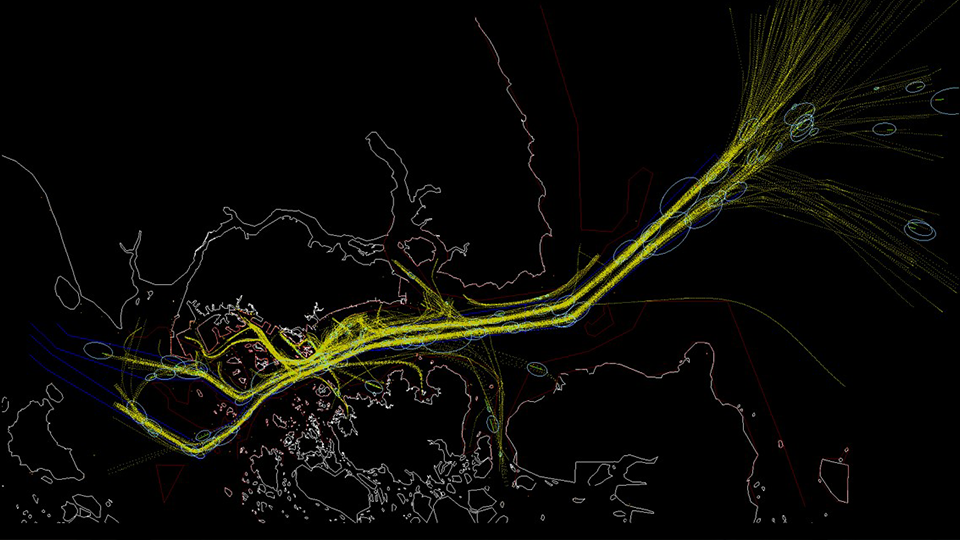
This tool simulates vessel traffic, creating simulation models based on current traffic conditions (such as traffic surveys and AIS data analysis). It can predict future changes in traffic volume, route changes, and the effects of deregulation (like overtaking restrictions) on traffic. It also allows for risk assessment simulations in simulated traffic environments to predict the impact of environmental changes on vessel traffic.
Tools
02
Mooring Motion Simulation
Purpose
- Evaluate the safety of vessels moored at quays, piers, and buoys
Content
This tool reproduces the motion of vessels moored at quays, piers, or buoys under external forces such as waves, wind, currents, and long-period swells. It analyzes factors like mooring line tension and fender compression to evaluate mooring safety. Simulations can also be performed for floating structures moored ship-to-ship, not just for land-based facilities.
Tools
03
Logistics Simulation (Queue Simulation)
Purpose
- Evaluate the capacity and efficiency of cargo handling and vessel allocation
- Plan more efficient cargo handling and vessel allocation
Content
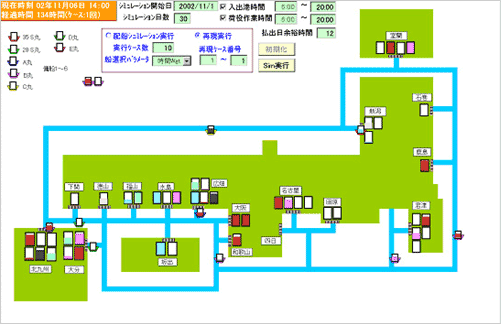
This queue simulation tool evaluates the relationship between service/capacity and efficiency for cargo handling rates, equipment capacity, optimal vessel allocation, and control planning. It is used to optimize the quality and quantity of services from an efficiency perspective. Typical examples include vessel allocation simulation and container terminal simulation.
Vessel Allocation Simulation
This simulation calculates the relationship between stockpiles at land bases (such as coal and oil) and vessel allocation in detail. It considers cargo handling efficiency, seasonal factors, and vessel delay factors, allowing for advance simulation. It is useful for determining the number of operating vessels, cargo handling equipment, and allocation methods for efficient operation.
Container Terminal Simulation
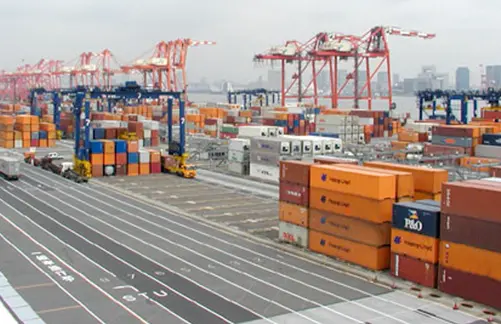
This is used to study container terminal layouts. It can determine differences in cargo handling efficiency and truck waiting times depending on the layout, enabling the consideration of more efficient operation methods for the same berth area or trucks.
FAQ
1.Verifying the streamlining effect of installing virtual buoys at the entrance of Tokyo Bay
2.Verifying the safety improvement effect of imposing speed and overtaking restrictions in the Singapore Strait
・Verifying mooring safety for larger LNG vessels at dedicated hazardous material piers
・Evaluating mooring limits during tsunami events caused by major earthquakes
・Assessing mooring safety for large tankers moored to buoys
・Evaluating mooring reinforcement during improvements to mooring bollards and fenders